Guide
Renovating a period home without undoing what makes it worth having.
Chester is full of Victorian and Edwardian housing — bay-fronted terraces in Hoole, solid-walled townhouses nearer the walls, and a lot of properties where a well-meant modern repair has quietly made things worse. Six things worth understanding before you start.
Solid walls breathe — and they punish you if you stop them
Most Chester housing built before about 1920 has solid brick walls with no cavity.
A solid wall manages moisture by letting it move through and evaporate away. Wrap it in impermeable modern materials — cement render outside, gypsum and vinyl paint inside, foam insulation in the middle — and the moisture stops moving. It does not disappear; it collects, and it shows up as damp on the inside face, blown plaster and, eventually, rot in embedded timbers.
That does not mean you cannot insulate a period house. It means the build-up has to be a breathable one, and it means being very careful about what goes on the outside. This is the single most common expensive mistake in period renovation, and it is always made with the best intentions.
Nothing is square, plumb or level — and that is a scribing job
A hundred and thirty years of settlement puts every opening slightly out.
Fit a door lining straight out of the pack in a house like that and you get a wedge-shaped gap at the head that no amount of filler will disguise. Second-fix joinery in a period property is therefore a scribing job: architraves eased to follow the wall, skirtings cut to the floor rather than to a chalk line, doors hung to the opening that actually exists.
It takes longer. It is also the entire visible difference between a house that has been renovated and one that has been patched up, and it is the first thing a surveyor notices.
Lath and plaster: keep it or lose it, but decide deliberately
Original ceilings and stud walls are lime plaster on timber laths.
Where it is sound, lath and plaster is worth keeping — it is breathable, it has some acoustic mass, and a ceiling with its original cornice intact is worth real money on a period house. Where it has parted from the laths, it will come down eventually, usually at an inconvenient moment.
The honest test is whether it moves when you press it and whether there are long horizontal cracks. If it goes, the replacement should be decided on more than cost: plasterboard is cheaper and faster, but on a listed or conservation-area property a lime replastering may be the right answer and occasionally the required one.
Chimney breasts: the most under-estimated structural job in the house
Removing one is not a demolition job, it is a support job.
A chimney breast carries its own considerable weight, and the stack above it in the rooms and roof carries on existing after you have taken the bottom out. Removing one at ground floor means supporting everything above it, usually on gallows brackets or a beam, to an engineer’s calculation.
They are also worth thinking about twice. A removed breast gains usable floor area in one room and loses the chimney, the alcoves and — in the eyes of a lot of buyers — the character of the room. It is a genuinely two-sided decision.
Original floors are usually worth more than what replaces them
Under most period carpets is a pine boarded floor with a century of patina.
They are often in better condition than they look, and the cost of lifting, repairing, filling and sanding is frequently less than the cost of a decent engineered board laid over the top of them. The catch is that boards over an unheated void are cold and draughty, so if you keep them, deal with insulation and draught-proofing at the same time rather than a winter later.
Where boards genuinely have to come up — for structural repair, services or a new floor build-up — it is worth numbering and keeping the sound ones. They are the best possible material for patching elsewhere in the house.
Services: assume the wiring and the pipework are older than you think
An extension or a knock-through is the moment to deal with them.
Rewiring a house is disruptive because it means chasing walls and lifting floors. Doing it while the walls are already open for a renovation costs a fraction of doing it as a standalone job later, and the same is true of heating pipework and any remaining lead or galvanised supply.
It is also the only moment when the lighting plan is free to change. Once the plaster is on, moving a switch means a chase, a patch, a repaint and a bad mood.
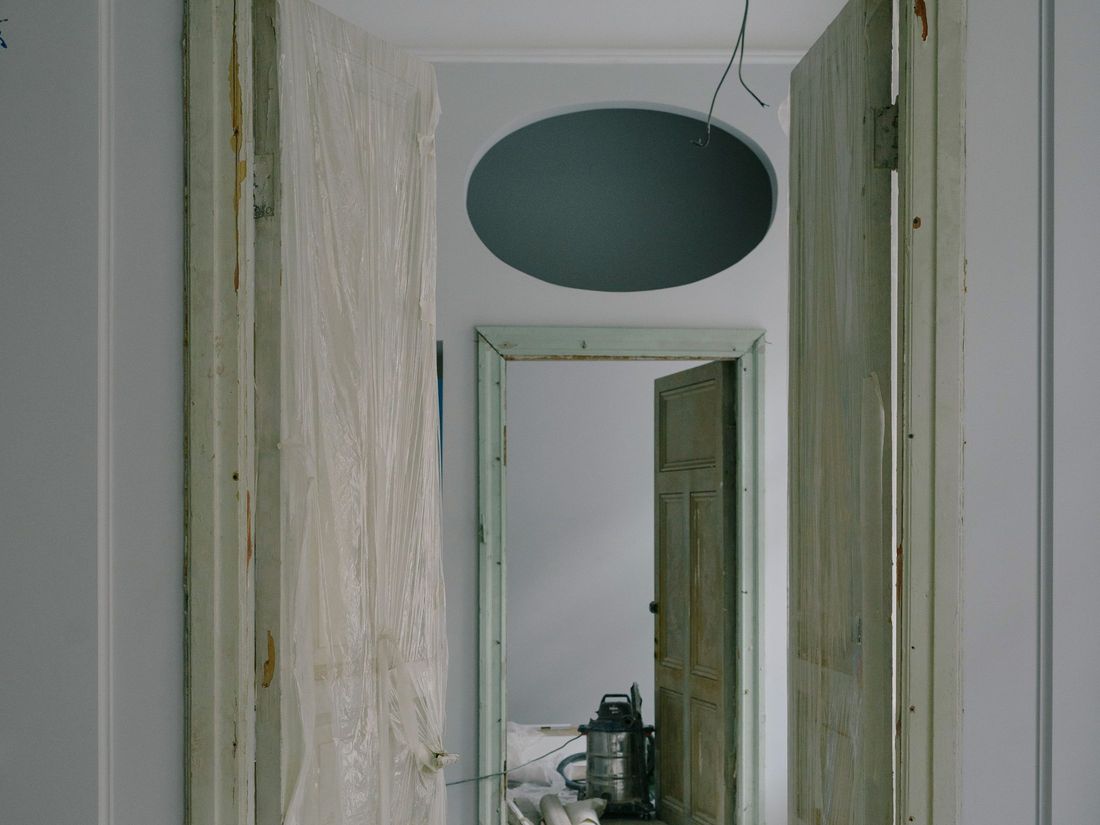
Second fix in a settled house is a scribing job, not a cutting job
Got one of these houses?
We will tell you what is worth keeping — including when that is most of it.
A first visit on a period property is mostly diagnosis: what the walls are doing, what has already been done to them, and which of the things on your list will pay for themselves. Ring the office and we will come and look.